
Many companies treat an ERP (Enterprise Resource Planning) implementation like a magic wand. They expect that simply buying the software will instantly organize their chaos.
Many companies treat an ERP (Enterprise Resource Planning) implementation like a magic wand. They expect that simply buying the software will instantly organize their chaos. However, the hard truth is that an ERP is only as good as the automation driving it.
If you want your implementation to actually stick, you have to stop looking at software as a storage bin and start looking at it as a living system.
The Analogy: Memory vs. Brain
To understand why automation matters, think of your company as a human being.
- Data is the "Memory": It’s the collection of facts, figures, invoices, and customer names. It tells you what happened in the past.
- Process is the "Brain": It’s the logic that decides what to do with that memory. It’s the "if this, then that" of your daily operations.
A company with great data but no automated processes is like a person with a perfect memory but no cognitive function—they remember everything but can’t decide how to move their legs. Effective automation ensures the "brain" is wired correctly before you start filling the "memory."
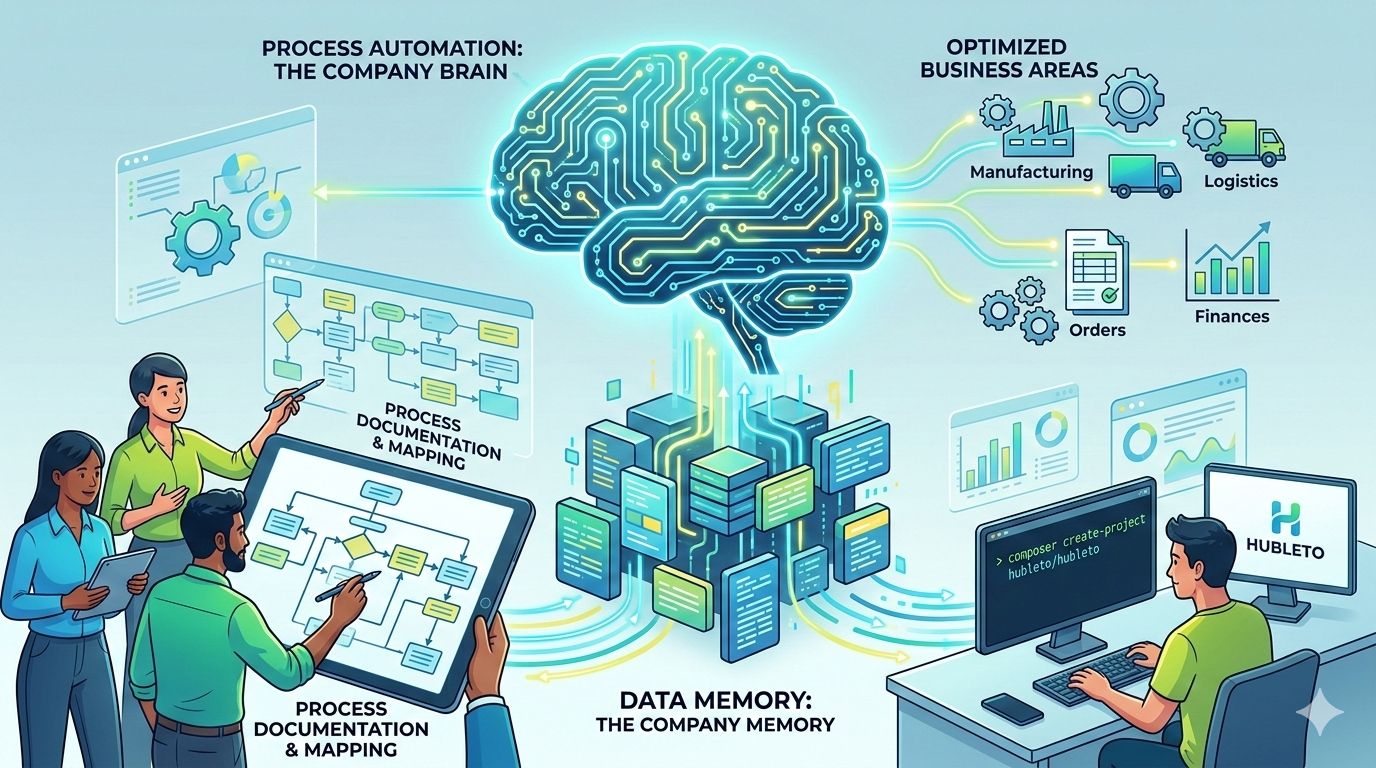
(source: www.pixabay.com, www.freepik.com, Google Gemini)
Why Open Source is Your Secret Weapon
When automating, many firms fall into the trap of expensive, "black-box" proprietary software. This often leads to vendor lock-in and a reliance on outside consultants who don’t actually understand your day-to-day grind.
Open-source ERP solutions change the game because they allow you to utilize your internal staff. Your own IT team or tech-savvy managers can dive into the code, tweak the workflows, and customize the automation to fit your specific culture.
Benefits include:
- Reduced Licensing Costs: Redirect that budget toward training your team.
- Total Sovereignty: You own the logic; the "brain" belongs to you, not a third-party vendor.
- Agility: When your process changes on Tuesday, your internal team can update the automation by Wednesday.
Putting it into Practice: Installing Hubleto
If you’re looking for a lean, developer-friendly way to start automating processes, Hubleto is a ready-to-use open-source choice. It’s built to be modular and easy to deploy.
Because it's built on modern PHP standards, you can get the foundation running quickly using Composer, the industry-standard dependency manager.
The Installation Process
To install the Hubleto core into your environment, you need to have PHP experience and a tool called composer. Then simply run the following command in your terminal:
composer create-project hubleto/erp-project
Once the dependencies are pulled, you can configure your environment variables and begin implementing your specific business logic directly into the framework. This "developer-first" approach ensures that your automation is baked into the code, not just layered on top as an afterthought.
Conclusion: Document or Die
Automation is powerful, but it is not a substitute for clarity. You cannot automate a process that you don't understand.
The most successful ERP implementations don't start with code; they start with a pen and paper. You must properly document your company's processes and data structures before you attempt to digitize them. Without documentation, automation just helps you make mistakes faster.