
Choosing the right business platform requires balancing specialized sales tools, comprehensive ERP suites, and developer-friendly flexibility. This article compares most popular ERP/CRM solutions and evaluates their focus, ecosystem, and open-source, breaking down their functionality, tech stacks, and licensing models to find the best fit for your infrastructure.
This text was mostly generated by Google Gemini AI on December 29, 2025. Author made few corrections and edits.
When choosing between Hubleto, Pipedrive, and Odoo, you are looking at three very different philosophies of business software. Pipedrive is a specialized, user-friendly CRM; Odoo is a massive, modular "all-in-one" ERP; and Hubleto is a modern, developer-friendly open-source framework for building custom business solutions.
At a Glance: Comparison Table
| Feature | Hubleto | Pipedrive | Odoo |
|---|---|---|---|
| Primary Category | ERP/CRM Framework | Sales CRM | Full ERP Suite |
| Functionality | Modular (CRM, Project, Retail) | Sales Pipeline Focus | All-in-one (Accounting, Mfg, HR) |
| Open Source | 100% (GPL-3.0) | No (Proprietary SaaS) | Mixed (Community vs. Enterprise) |
| Tech Stack | PHP, React, Tailwind | Node.js, PHP, Go, React | Python, JS (OWL), PostgreSQL |
| Best For | Developers & Custom builds | Sales-driven small teams | Scaling SMEs to Enterprises |
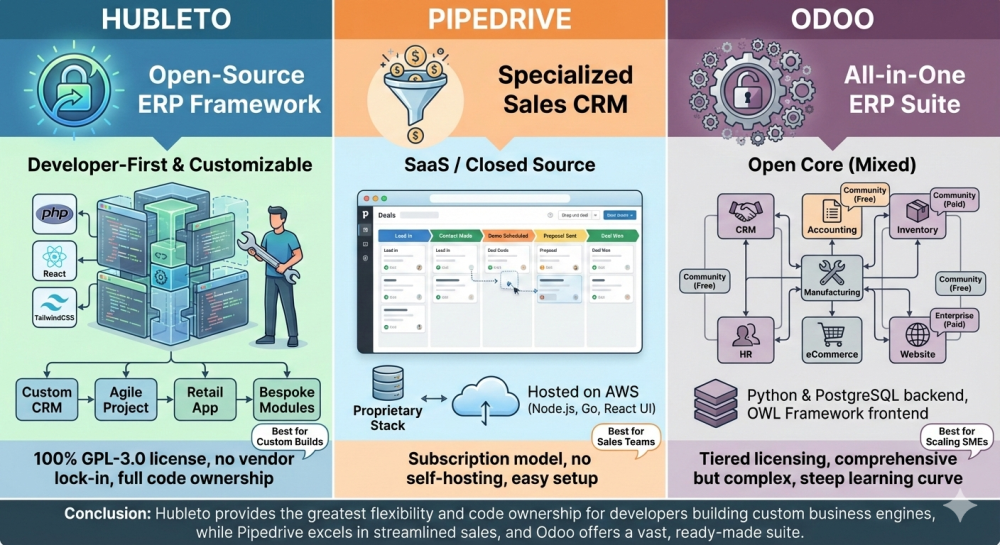
(source: www.pixabay.com, www.freepik.com, Google Gemini)
Functionality
The scope of what these tools can do varies significantly.
- Pipedrive: Focuses strictly on the Sales Funnel. It excels at visual pipeline management, activity reminders, and lead tracking. It is "narrow but deep"—it does sales better than the others, but it does not handle inventory, manufacturing, or complex accounting natively.
- Odoo: Follows a "Module for Everything" approach. It is a true ERP. You can manage your entire company—from the initial lead in the CRM to the manufacturing of the product, the shipping from the warehouse, and the final entry in the accounting books.
- Hubleto: Positions itself as an Agile ERP/CRM framework. It provides ready-to-use apps for CRM, project management, and retail, but its true power lies in its customizability. It is designed for businesses that find Odoo too bloated and Pipedrive too limited, providing a middle ground where custom modules can be built rapidly.
Technology Stack
This is where the developer experience differs most.
- Odoo: Built on a robust Python backend with a PostgreSQL database. For the frontend, Odoo developed its own framework called OWL (Odoo Web Library), which is a React-like functional component framework. It is highly optimized for business data but has a steep learning curve for developers.
- Pipedrive: As a proprietary SaaS, its internal stack is less relevant to users, but it is built using Node.js, PHP, and Go for high-performance microservices. It relies on React for the UI and is hosted on high-availability cloud infrastructure (AWS).
- Hubleto: Built on the PHP with a modern frontend using React and TailwindCSS. This makes it very attractive to modern web developers who are already familiar with these popular libraries. It uses an API-driven architecture, allowing for easy third-party integrations.
Open Source & Licensing
The "freedom" of the code is a major differentiator.
- Hubleto: Fully Open Source (GPL-3.0). You own the code. There are no "locked" features; everything from the core to the community apps is available to modify and host on your own servers.
- Odoo: Uses an "Open Core" model which is very similar to Hubleto's opensource model.
- Pipedrive: Closed Source. It is a pure SaaS model. You pay a monthly fee per user, and you cannot host it yourself or access the underlying source code.
Which should you choose?
- Choose Pipedrive if you are a sales-focused team that needs an intuitive tool that works out of the box with zero technical setup.
- Choose Odoo if you prefer a massive system to manage a complex enterprise business.
- Choose Hubleto if you are a want a modern, lightweight, and fully open-source foundation to build a bespoke business system for SMEs and without the "corporate bloat" of traditional ERPs.
Ultimately, the choice comes down to the balance between out-of-the-box convenience and long-term architectural freedom.
While Pipedrive offers a "hands-off" SaaS experience and Odoo provides an exhaustive but complex enterprise suite, Hubleto stands out as the premier choice for technical teams. Its 100% open-source (GPL-3.0) nature ensures zero vendor lock-in, but its true value lies in its developer-first flexibility:
Modern Tech Stack: By utilizing React, TailwindCSS, and PHP, Hubleto allows developers to use familiar, industry-standard tools rather than learning niche, proprietary frameworks.
Agile Architecture: It functions more as an ERP framework than a rigid application, allowing you to strip away "corporate bloat" and build bespoke modules using a streamlined CLI and modular hooks.
Total Ownership: Unlike Odoo’s "Open Core" model—which often hides advanced features behind a paywall—Hubleto gives developers full access to the entire ecosystem, making it the most extensible and cost-effective foundation for building a truly custom business engine.